
PROVOCATIONS
Adolf Loos once declared that “only a very small part of architecture belongs to art: the tomb and monument (“Grabmal” and “Dekmal”) and everything else which serves a purpose should be excluded from the realms of art”. [1] The sweeping statement implies that the function is not spatially based so that “forms” without spatial objectivity or functionality could be possible. Hence, these “forms” could also belong to art since the ‘forms’ are not obedient to function, structure or materials. These are simply self-referential ‘forms’ that obey an inherent “non-architectural logic” and [2] exist with no functional obligation.
That said, it can also be argued that there is a transparent area common between architectural forms that possess sculpture-like properties and large-scale “enterable” sculptural works, which simulate architecture. For this reason, Frank Gehry’s architectural form [3] emulates the poetry of sculpture in the same way as Richard Serra’s sculpture [4] imbibes and captures architectural spaces.
The idea is to explore works that can fluctuate and simultaneously reside in the overlapping boundaries between the distinctive base planes of the visual arts, sculpture and architecture, which can effectively blur or hold in abeyance their respective exclusivity. For this reason, the 2D artworks can be employed to de-materialize the skin of an architectural form so that the resulting image do not reflect any spatial functionality. With the resulting form encapsulating no utility, its function-less form becomes the generator of meaning and essentially also its substance just as a sculpture behaves. The meaning thus can fluctuate incessantly and fleetingly between the planar arts, its architectural image and its sculptural dimension. This is the infinity of that instance as it intermittently inhabit the realms of the arts, architecture and sculpture as installations and interventions.
The other dimension is to explore the fusion of an artwork as a foreign element into the host architecture, the built or the natural environment as an appendage installation. This presupposes the prior independent existence of the hosting architecture, the built-form and nature, in which the artwork can be grafted into as a virtual, temporal or permanent addition. Like an attached barnacle the artwork will rely on the host for framework, structural grounding or mounting. The function of the artwork is “form-al” and not spatially based as architecture functions. The “embodied artwork” establishes a new “presence” that may transform the setting and introduces a temporal relationship which may provoke the beholder’s consciousness.
Thus, the the re-mixed 2D art explorations/ mixed up artwork are 'appropriated' into 3D architectural/sculptural provocations. However, some of the artworks are straight sculptural explorations based on studies and conceptual sketches that were given flesh and bone, which became alive when virtually sited on varied locations. Likewise, the base artworks are explorations that employed the juxtaposed, layered, re-oriented, re-scaled previous artworks, which resulted into derivative artworks with their own respective identity.
That said, it can also be argued that there is a transparent area common between architectural forms that possess sculpture-like properties and large-scale “enterable” sculptural works, which simulate architecture. For this reason, Frank Gehry’s architectural form [3] emulates the poetry of sculpture in the same way as Richard Serra’s sculpture [4] imbibes and captures architectural spaces.
The idea is to explore works that can fluctuate and simultaneously reside in the overlapping boundaries between the distinctive base planes of the visual arts, sculpture and architecture, which can effectively blur or hold in abeyance their respective exclusivity. For this reason, the 2D artworks can be employed to de-materialize the skin of an architectural form so that the resulting image do not reflect any spatial functionality. With the resulting form encapsulating no utility, its function-less form becomes the generator of meaning and essentially also its substance just as a sculpture behaves. The meaning thus can fluctuate incessantly and fleetingly between the planar arts, its architectural image and its sculptural dimension. This is the infinity of that instance as it intermittently inhabit the realms of the arts, architecture and sculpture as installations and interventions.
The other dimension is to explore the fusion of an artwork as a foreign element into the host architecture, the built or the natural environment as an appendage installation. This presupposes the prior independent existence of the hosting architecture, the built-form and nature, in which the artwork can be grafted into as a virtual, temporal or permanent addition. Like an attached barnacle the artwork will rely on the host for framework, structural grounding or mounting. The function of the artwork is “form-al” and not spatially based as architecture functions. The “embodied artwork” establishes a new “presence” that may transform the setting and introduces a temporal relationship which may provoke the beholder’s consciousness.
Thus, the the re-mixed 2D art explorations/ mixed up artwork are 'appropriated' into 3D architectural/sculptural provocations. However, some of the artworks are straight sculptural explorations based on studies and conceptual sketches that were given flesh and bone, which became alive when virtually sited on varied locations. Likewise, the base artworks are explorations that employed the juxtaposed, layered, re-oriented, re-scaled previous artworks, which resulted into derivative artworks with their own respective identity.
- Adolf Loos, 1910, as quoted in George Baird, The Space of Appearance (Cambridge, Mass: MIT Press, 1995, p129.
- See Robert Harrison, Thirteen Ways – Theoretical Investigations in Architecture (Cambridge, Mass: MIT Press, 1997) p17. See also Fredinel Banaag, Homage Pavilions as Experiential Memorials, an Architectural Design Exploration, (Makati: Hanabana Publishing, 2014) p25.
- See various websites: https://www.architecturaldigest.com/gallery/best-of-frank-gehry-slideshow [Accessed: September 02, 2017]; https://www.guggenheim-bilbao.eus/en/the-building/ [Accessed: September 02, 2017]
- See various websites: https://www.gagosian.com/artists/richard-serra [Accessed: September 02, 2017]; https://www.guggenheim-bilbao.eus/en/exhibitions/richard-serra-2/ [Accessed: September 02, 2017]
I have been building up my creative explorations on the shared fringe boundaries where art, architecture and sculpture can mutually inhabit. This is in the form of virtual installations or interventions that for all their properties can also be rightfully classified as sculpture. These installations / interventions were “appropriated” from my varied previously-done studies, explorations, concepts and ideas into ‘3D virtualization’, which I term as “provocations”.
#ARTPROVOCATION #ARTINSTALLATION #INSTALLATION #INSTALLATIONART #VIRTUALINTERVENTION
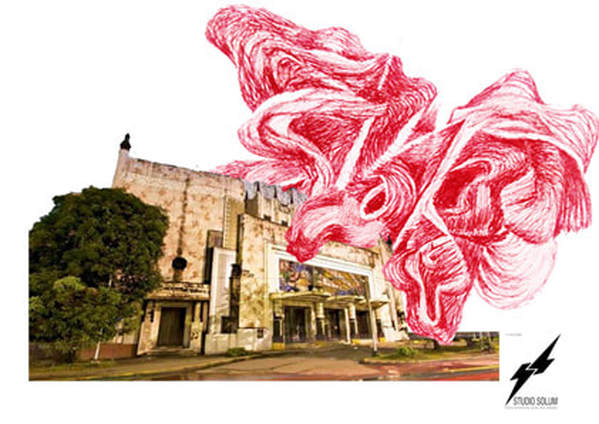
THE INTRUDER OF THE METROPOLITAN THEATRE
Can an old structure be re-purposed and up-cycled for another program and be re-adapted to serve another set of users? Yes of course. But can the same old structure be restored to its former glory and serve the same set of functions? It can be done albeit with its former spirit having long abandoned its body. The main nuanced property of architecture is the non-synchronous life span of its varied components; where the superstructure may continue to be effective in a hundred years. This of course outlasts its functional program. Consequently, the utilities, furnishings, finishing, etc will all slowly disintegrate, even with regular maintenance. So the 'spirit of the times' that the structure was anchored on may have long morphed and eloped with another era's spirit. Can the faded glory be enticed back? This is in essence an architectural intruder, forcefully inhabiting the old shell of the Metropolitan Theatre.
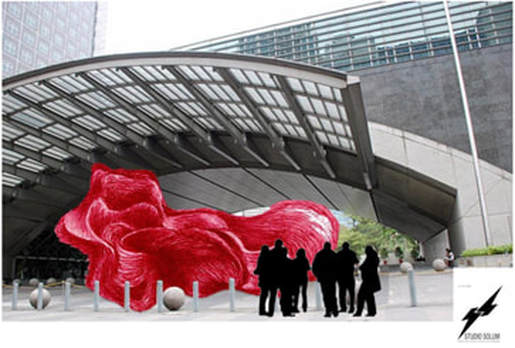
THE GATE CRASHER
The tower one's porte cochere is an enviable portal with its air of grandness and exclusivity and yet at the same time the wide overhanging welcoming arch leads to the greenery beyond. I wanted to somehow rattle this fused spatial relationship, to agitate its serene setting- hence this Gate Crasher.
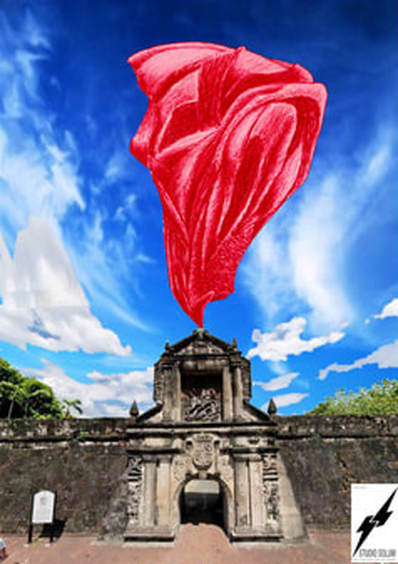
THE FORT SANTIAGO INTRUDER
Fort Santiago is embedded in a very dense past. The collective remembrance is perpetuated by the stones that are historically, politically and culturally institutionalized. I wanted to agitate this set up with a non-invasive installation and with as little as possible footprint.
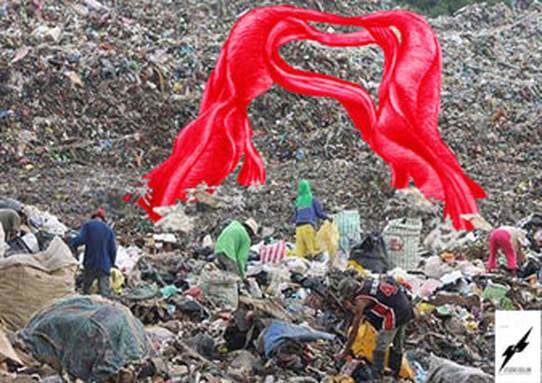
THE ARCH OF PAYATAS
"Venustas" or delight is traditionally always on the bottom of subsistence ladder- to live simply to exist. Can 'venustas' inhabit also the dump site as this 'arch of payatas' ?
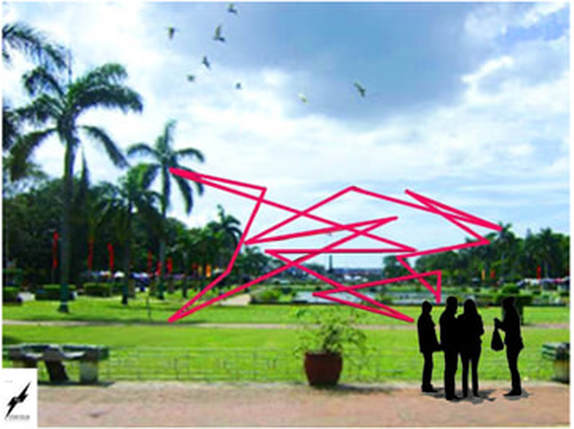
GEN LUNA AT LUNETA
Line images find its abstraction on the kanji or chinese character. This is how i see Gen. Antonio Luna charging forth on horseback at the Luneta park.
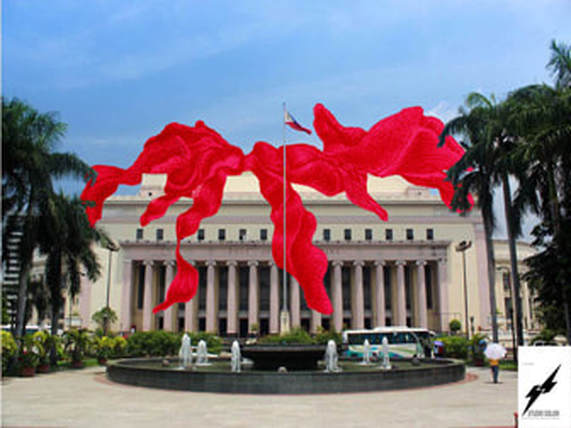
THE SPIRIT OF THE TIMES ABANDONING THE POST OFFICE BUILDING
The (remnants of) 'spirit of the times' finally abandoning the former central post office building- a very prominent casualty of the internet.
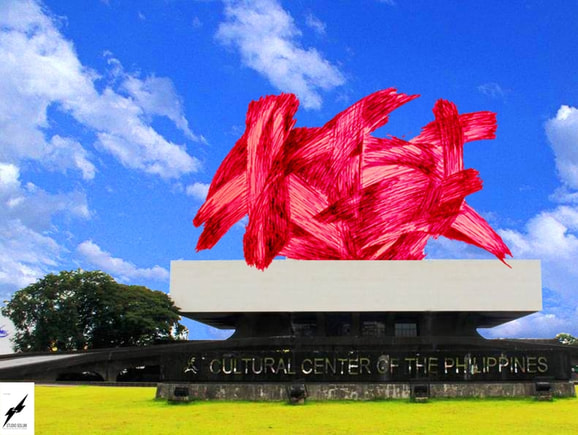
THE INTRUDER UNSETTLING THE CCP
The Cultural Center of the Philippines is the 'primary' icon of modernist architecture and is the epitome of Philippine Contemporary architecture. In a hundred years this might be lost and this is just a speculation on what could be an unwelcome "intruder". The Intruder is simply there to unsettle and agitate.
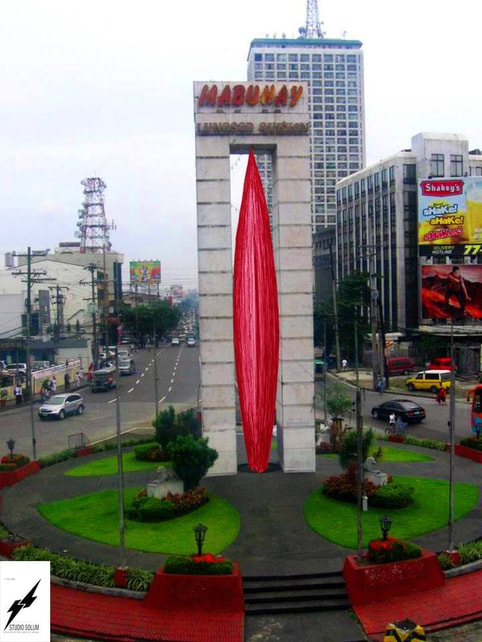
THE "WELCOME" INTRUDER
This is then welcome rotunda landmark. I like its formality, its tall masculine robustness, its symmetry and formality. I wanted an installation that would snugly fit it, and not overpower it but home in to it- an "unwelcome" welcome rotunda intruder!
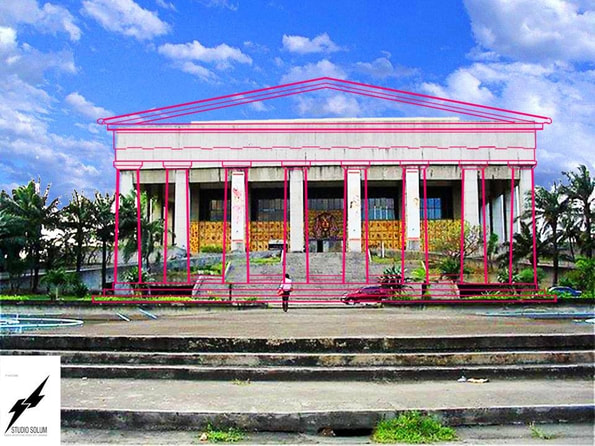
THE GHOST OF THE FILM CENTER
There are stories that the former film center is inhabited by the ghosts of the construction workers. (you can probably google this).
It seems that the "lines" of the parthenon can also be traced over the building! Hence, this could be the 'other ghost' of the former film center.
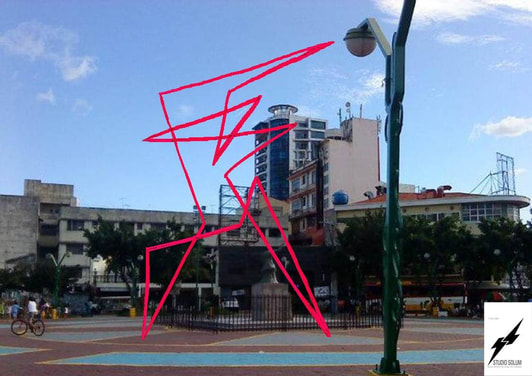
MICHAEL
This is in remembrance to the former energy, glory and whathaveyou of the remedios circle on the 70's, 80's and the 90's- the non-smartphone, no-internet decades with michael (jackson) of the same decades.